
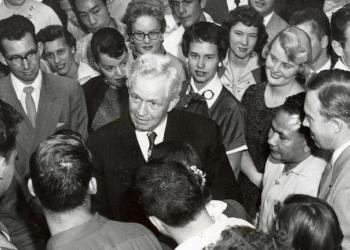
Why McKay?
In 1996, the BYU College of Education changed its name to the David O. McKay School of Education. David O. McKay was not only a passionate educator but also an apostle and prophet of The Church of Jesus Christ of Latter-day Saints for 45 and 19 years, respectively, during some of the most pivotal decades of the 20th century. Thus, our namesake highlights the marriage of two values: rigorous education and gospel-centered learning. Read on to learn more about David O. McKay—who he was, what he taught, and why we honor him today.
An Inspired Upbringing
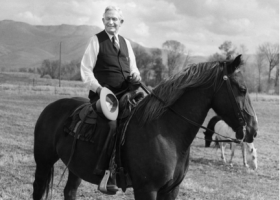
David Oman McKay was born on a farm in Huntsville, Utah on September 8, 1873. McKay’s mother, Jennette, worked as a teacher prior to her marriage. Though his father, also named David, was deprived of formal education, he studied diligently on his own and became one of the founders of Weber College (now Weber State University). Largely through his parents’ example, President McKay learned that education stood at the center of a successful life.
After finishing grade school, McKay went on to study at Weber Stake Academy. After graduating, he became the principal of a community school in Huntsville. At about this time, McKay’s grandmother, upon her death, granted $2,500 to his mother. Many urged Jennette McKay to invest the money in bonds. She refused. “Every cent of this,” she declared, “will go to the education of [my] children.”
Accordingly, in 1894, McKay and his siblings packed a wagon with supplies and headed for the University of Utah. At the university, on top of handling a demanding class load, McKay played on the school's first football team and finished his college career as president of his class. This well-rounded approach to learning would become an integral part of his philosophy of education, which prized the development of the whole person: social, physical, intellectual, and spiritual.
Leadership in Learning
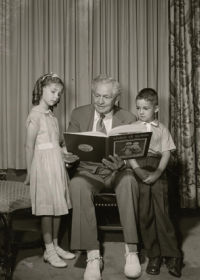
After completing a mission to Scotland in 1899, McKay returned home to marry Emma Mae Riggs, his college sweetheart. Both began work as teachers in Ogden, Utah: Emma at Madsen School and he at Weber Stake Academy. Within three years, he was promoted to principal and initiated a campaign for campus expansion. Now known as Weber State University, the school is a testament to his foresight.
Part of Principal McKay's expansion plans focused on programs to attract female students. By October 1904, administrators noted that half of those applying for registration were women. For David O. McKay, education was a right for all people, regardless of age, race, or gender.
During his tenure as principal, McKay also served as assistant superintendent of the Weber Stake Sunday School. His leadership was marked by innovation. He wrote lesson outlines and established an in-service program.
On April 8, 1906, at the age of 32, David O. McKay was called as an apostle of the Lord. In addition, he served in the general Sunday School presidency and, as superintendent, oversaw Sunday Schools from 1918 to 1934. After his release from the Sunday School, McKay continued to write Church lessons for 17 more years until he became president of the Church.
An Eternal Education
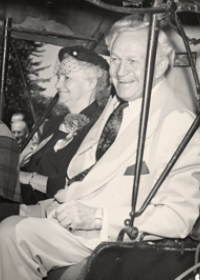
In 1951, at age 78, Elder David O. McKay was ordained and set apart as prophet and president of The Church of Jesus Christ of Latter-day Saints. The transcontinental railroad had been completed shortly after his birth; man would reach the moon shortly before his death. McKay would rightfully be credited with leading the Church into the modern era. But with the advance of time and technology came an accompanying surge of social problems. McKay had long seen education as a key to combating these issues. In his view, it was the very root of democracy—even civilization itself.
By the end of his life, McKay had served as a General Authority for nearly 64 years. In the process, he received five honorary doctoral degrees in recognition of his educational contributions. Each of the many responsibilities McKay assumed throughout his life was influenced by his never-ending role as an educator. With an emphasis on high ideals, equal opportunity, and lifelong learning, David O. McKay extended his vision of education beyond the lecture and the textbook to mold spirits and span the eternities.
This article has been adapted and updated from the 2005 McKay Today article “Our Namesake—David O. McKay: Prophet and Educator.”
Learn More about David O. McKay
- David O. McKay and the Rise of Modern Mormonism
- The Teachings of David O. McKay
- Teachings of Presidents of the Church: David O. McKay
- David O. McKay: Beloved Prophet
- David O. McKay's Progressive Educational Ideas and Practices, 1899—1922
- To The Peripheries of Mormondom: The Apostolic Around-the-World Journey of David O. McKay, 1920–1921
- The Rhetoric of David O. McKay: Mormon Prophet
- Heart Petals: The Personal Correspondence of David Oman McKay and Emma Ray McKay
- Additional Talks by David O. McKay