
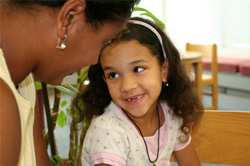
A mother keeps a post-it note on her mirror, written by her daughter when she was four years old, that reads "I did it on accenendent!" The mother's forgotten what it was the daughter did on accident so many years ago: break a bowl? Slam a door? It doesn't really matter now.
What does matter is the relationship with her daughter who is now nine years old. The post-it stays because that child's plea is so often consistent with the mother's own, "I didn't mean to. I didn't want it to turn out that way. I did it on accident." Mistakes are a part of life, and teaching children to handle them in positive ways is part of parenting.
BYU researchers remind parents that we are always teaching our children (Young et al.). How we respond to our children's mistakes will likely teach them how to respond to their own. What will they take from us?
Will they punish themselves harshly?
Will they let themselves off too easily?
Will they be pleased if they can "get away with it"?
Or will they realize mistakes are part of growth: correct the problem, and move on?
Sometimes all a mistake calls for is forgiveness. Most times, allowing the child to experience the consequence and handle the mistake is also in order.
Let consequences do their work
One child is found in his room, serving a self-imposed timeout. Another child would look you straight in the eye and say he didn't do it, even if he did.
Kids come with differing levels of tolerance for making mistakes and their own levels of wanting to correct them.
Parents have the privilege and responsibility to discipline. "Children need clear expectations and standards provided by responsible adults to help guide and direct their lives" (Young et al. 13).
Loving parents teach their children how to cope effectively with mistakes. This includes not removing the natural consequences that accompany them.
Mistakes as opportunities
Parenting experts Cline and Fay have a chapter in Parenting with Love and Logic titled "Children's Mistakes Are Their Opportunities" (51).
They write, "Oftentimes we impede our kids" growth. We put ourselves exactly where we shouldn't be: in the middle of their problems. Parents who take on their kids' problems do them a great disservice" (52).
"When a child causes a problem, the adult shows empathy through sadness and sorrow and then lovingly hands the problem and its consequences back to the child" (55).
A parent who allows his child to correct her own mistakes will teach that child she is powerful.
Teaching, not "I told you so"
BYU researchers led by K. Richard Young suggest we treat our children with respect, and make sure our messages are "clearly and precisely explained" (12).
This means that a child's mistake is not a moment where we get to add any insult to injury (although we may be tempted to say I told you so). Mistakes are often opportunities for teaching what a more correct choice would have been.
Modeling is one of the best ways to teach correct behavior. This works especially well with younger children (Young et al. 12). If you have a child who is pushy on the playground, model how he could deal with his emotions in a positive way. Let him role play correct behavior with you.
With older children and their mistakes, they may use you as a sounding board, but typically need to figure out solutions on their own.
Natural Consequences
Allow natural consequences to take place when children make mistakes. Our natural parental response is to protect our children, which can get in the way of allowing consequences to do their work. If Sam gets a traffic ticket, allowing him to earn the money to pay it will teach him he has the power to deal with mistakes. If there's a chore undone, following through with the consequences you've set in place will teach your daughter that actions (or inactions) have repercussions.
When To Step In
Parenting experts Cline and Fay suggest that parents rarely step in when children are dealing with mistakes or problems. Parents are encouraged to step in "when our children are in definite danger of losing life or limb or of making a decision that could affect them for a lifetime" (54). Also, step in if there is a situation we know the child cannot handle, and the child knows he cannot handle. "If there's more than a 20 percent chance our child might be able to work it out, we should keep clear of owning the problem" (54).
"Uh-Oh Song"
Cline and Fay suggest responding to children's mistakes with sadness and empathy, but handing responsibility for the mistake back to the child. This can be achieved by saying something along the lines of "'Oh, how sad. That never turns out very well for me when I do that,' or something else along those lines" (59).
Magnifying Glass
We often find what we're looking for in others. Keep yourself focused on the positive as much as possible with your children. Neal A. Maxwell wrote, "We should . . . without being artificial, regularly give desired, specific praise. One of the reasons for doing this is that we are all so very conscious of our shortcomings that it takes a persistent pattern of appreciation to finally penetrate" (qtd. in Young et al. 15).
Consistency
BYU researchers remind parents that one of the most important elements in parenting is consistency (Marchant and Young 22). A hit-and-miss attitude about how we manage mistakes is confusing for children.
Large, Small: Come One Come All
Mistakes can give us an opportunity to teach children about the fact there is no mistake large enough it cannot be corrected, no mistake small enough that we can be deceitful about it. Of course, it's easier to correct mistakes in the early stages, but teaching children about the atonement, during a "small" moment like an outburst between siblings will help them understand the power available to them for change and growth.
Your Good Example
Verbalize what you do to deal with mistakes. "I forgot I was in charge of visiting teaching, and we missed it this month. It makes me feel bad. I'm going to apologize to my partner and I'll take charge of teaching the next two months." This is an easy way to teach about healthy ways to deal with mistakes.
Forcing "I'm Sorry"?
Here's a tricky situation: your toddler just shoved your friend's daughter off of her trike. What do you do? Demand she perform the teary apology? Actually, the moment of teaching might be best handled later, or "ahead of time"--before the next play date. Research done by Young et al. suggests "learning occurs best under pleasant circumstances" (12). A lesson about "I'm sorry" and what that means might entail writing a little note of apology, or simply knowing what to do next time.
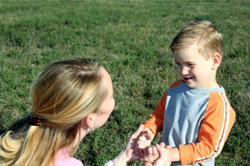
President Faust said, "Direction and discipline are . . . an indispensable part of child rearing. If parents do not discipline their children, then the public will discipline them in a way the parents do not like."
We get to help our children take responsibility for their mistakes.
"Kids who deal directly with their own problems are moved to solve them. They know that if they don't, nobody will. Not their parents, not their teachers—nobody. And on a subconscious level, they feel much better about themselves when they handle their own problems" (Cline and Fay 53).
Sources
Cline, Foster and Jim Fay. Parenting with Love and Logic. USA: Pinion Press,
2006.
Faust, James E. "The Greatest Challenge in the World—Good Parenting",
Ensign, November (1990): 31-34
Marchant, M. & Young, R. (2005). 3 B's of effective parenting: Be proactive, be positive, and be
consistent. Marriage and Families, (Winter), 18-25.
Young, Richard K., Sharon
Black, Michelle Marchant, Katherine J. Mitchem, and Richard P. West. "A Teaching Approach to Discipline:
An Alternative to Punishment." Marriage & Families, August (2000): 9-15.