
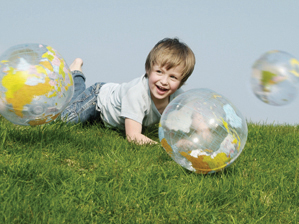
Dr. Edward M. Hallowell says in his book on how to raise happy children into happy adults, "if there is any better way to strengthen a brain, or to feed the spirit, than to play, I don't know what it is" (104).
Play is such a crucial element of a child's life that is has been called the "work of childhood."
It is through play that children make connections between themselves and the world. Play is essential for a child to develop in healthy ways. We'll look at ways we can help children make the most of their play.
"Birds fly, fish swim, and children play" -Dr. Gary Landreth
Dr. Edward Hallowell defines play as "any activity in which there is room for spontaneous invention and/or change" (103).
"Play time" should be a time not completely directed by parents. We can certainly take part in our child's play--often he is delighted to have us--but leaving a child alone in a safe place to play works its own kind of magic.
"The skill of play, of being able to make creative use of time no matter where you are or what you are doing, is the skill that lies behind all discoveries, all advances, all creative activity" (Hallowell 106).
Tools of play
Play therapist Dr. Gary Landreth encourages parents to keep play areas organized. Don't stress, we're not advocating pristine or immaculate, but do try to have things in the same place each day. Your kids should be able to help with keeping things in order at an early age.
Think of your child's toys as the tools she needs to get her work done: if she has to stop what she's doing because there are no markers to be found, the flow of her work is disrupted.
Make time for play
"Make time for play" (Hallowell 121). This principle might sound paradoxical: scheduling time for play, but we know too well how time flies. Sometimes we might even have to "un-schedule" other good activities to make time for play.
Dr. Gary Landreth also suggests creating time and space where children can play:"Children are deprived of joy when they are rushed to complete tasks . . . Places of calmness and patience should exist in all children's lives; for in the midst of calmness and patience, children can discover and test their inner resources" (53).
"Places of calmness and patience should exist in all children's lives;
for in the midst of calmness and patience, children can discover and test
their inner resources."
-Dr. Gary Landreth
Toy Collecting
About toys and materials, Dr. Landreth, a renowned play therapist, advises, "Toys and materials should be selected, not collected" (117). Just because cousin Ed gave Christopher a gun for his birthday doesn't mean you need to keep it around if you'd prefer not to. That goes for the McDonald's toys as well!
Play House
Not all of us have the luxury of giving our children a room dedicated to play. Consider introducing your child to some other places that can become magic: a corner in the yard, the back of your shoe closet, under the stairs. These (we have to say it: make sure they're safe places!) places can be some of the best spots of all for a child's imagination.
Limiting Electronic Time
"Limit electronic time" (Hallowell 116). While it is certainly possible for children to play well with a computer or on the internet, Dr. Hallowell urges parents to "preserve and protect for children" "the human moment" (116). This is any moment where children come into contact with other people, which is generally richer for children than time spent in non-human (electronic) ways.
Less Is More
Consider taking inventory of your child's most played with toys and clearing out whatever might be clutter. It's often the purse strap and the $1.00 microphone that are the most valuable items: the big, flashy remote control car may just be getting in the way.
Scheduling It
Try finding a time each day this week where unstructured play can be the number one priority for your child. If you have a safe place for your child, don't hesitate to simply leave your child alone or with a friend to play. When a child gets to direct her own play it is especially valuable.
Relearning How To Play!
A great suggestion for parents from Dr. Hallowell is for us to,"Relearn how to play as an adult" (122). He asks, "What is one practical way you can think of to encourage play in the lives of your children, yourself, and your family? Maybe you could go hide something right now and at dinnertime announce that after dinner there will be a game to see who can find the hidden thing. Or maybe you'll go buy a ball you don't have" (122). The possibilities are endless, and fun! What's something you can do to encourage play this week?
Youth Sports
Take care with youth sports (121). Youth sports should be a place for children to have fun. Hyper-competitive parents (we've all seen them) can quickly drain the fun out of an otherwise good time.
Blank Slate
Dr. Landreth also suggests that the more imagination a child can bring to the toy itself, the better. It might be best to have a plain wooden vehicle a child can push around and make the noises for (and that can morph into other types of imagined vehicles as needed) than a fancy, colorful truck that almost drives itself. Items like a bed sheet, scarf, and even an old purse can become magical when a child adds her imagination to them.
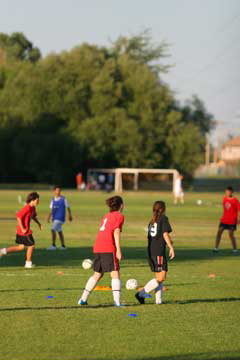
Fred Rogers, beloved children's TV personality said of play, "To grow up to be healthy, very young children do not need to know how to read, but they do need to know how to play" (qtd. in Landreth 49).
Play is essential in making connections to the world, figuring out how things work, and learning to create.
When you spot your son and his friend underneath the tree outside planning ways to fend off alien invaders, congratulate yourself. You've allowed him to do the work of childhood; you've given him time for play!
Sources
Hallowell, Edward M. The Childhood Roots of Adult Happiness. New York: Ballantine Books, 2002.
Landreth, Gary L. Play Therapy: The Art of the Relationship. Levittown, PA: Accelerated Development, 1991.