
Ecosystems in a Jar
Lesson Summary
- Identify producers, consumers, decomposers, and energy flow.
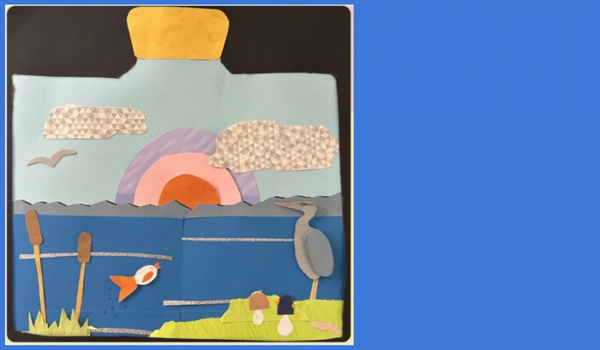
- Create a Utah “ecosystem in a jar” collage.
- Explain how environmental change influences conservation awareness.
Lesson Key Facts
- Grade(s): 6
- Subject(s): English Language Arts, Science, Visual Arts
- Duration of lesson: 90 minutes, 2 Sessions
- Author(s): Charlotte Hawkins, Dayna Koch
Lesson Plan and Procedure
Arts and Science Integrated Lesson
INTRODUCTION for Teachers:
Essential Questions:
- What are examples of Utah ecosystems? (Wetlands, Salt Lake Wetlands, Desert, & Mountain Forest)
- What is a food chain, and how do producers, consumers, and decomposers affect the food chain?
- What happens if you remove a component of a food chain?
- How do changes in living and non-living components affect an ecosystem? Real-world problems affecting the Great Salt Lake are drought and overuse of water.
Salt Lake is at its lowest recorded level in history. - How would water loss affect the surrounding environment?
- What can we do, as humans, to try to change the outcome?
- Where does all the energy come from? (The sun)
Vocabulary:
- Ecosystem: a biological community of interacting organisms and their physical environment.
- Producer: an organism that produces its own food through photosynthesis.
- Consumer: an organism that does not make its own food and gets energy by
eating a plant or animal. - Decomposer: an organism that digests or breaks down dead plants and animals.
- Food Chain: a hierarchical series of organisms, each dependent on the next as a source of food.
- Collage: the process of using pieces of paper to compose a larger piece of artwork.
Introduction to the artist: Rachel Ignotofsky is a New York Times bestselling author and illustrator based in Santa Barbara, California. Her work includes a beautifully illustrated book called The Wondrous Workings of Planet Earth. This book shows a wide variety of ecosystems around the world and the biology (producers, plants; consumers, animals; and decomposers, plants & animals & microbes) each system needs to thrive.
Lesson: Session 1
Upload Canva Slideshow: The Web of Life in a Jar Utah’s Ecosystems
Slide 2: Visible Thinking Routine: Looking Ten Times Two
Why we use this thinking routine: This routine helps students slow down and make careful, detailed observations by encouraging them to push beyond first impressions and obvious features.
For Teachers Only: Charlotte Hawkins demonstrating how to teach this thinking routine:
https://www.youtube.com/watch?v=rgIlxeWOYNw 4:07
1. Looking Ten Times (First Round of Observations)
Materials: Have students take out a piece of paper and a pencil and document what they see when you ask the following questions.
Teacher: Look closely at Rachel Ignotofsky’s illustration of an ecosystem. List 10 things you notice on your piece of paper. These can be objects, colors, lines, labels, patterns, or interactions between living things. Go beyond the obvious.
Student Output Examples: There are roots underground. The sun has rays reaching plants. Bees are flying near flowers. Labels explain what each part does’, etc. Encourage a variety of responses (not just animals).
2. Looking Ten (Times Two - Second Round of Observations)
Teacher: Now look again—this time, look deeper. What 10 new things do you notice now that you’ve already looked once? Write these down on your paper as well. Notice:
- Tiny details (textures, symmetry, hidden connections)
- Relationships (predator-prey, mutualism, energy flow)
- Artistic choices (color use, layout, balance)
- Scientific elements (diagrams, labels, cycles)
This round deepens attention and may lead to student insights like: The decomposer is connected to the plant roots. The arrows show movement through the food chain. There are invisible lines between pollinators and flowers. The artist repeats shapes to show balance in nature.
Focus Ideas:
Teacher:
- Can you identify the vital LIVING and NON-LIVING parts of this ecosystem as well?
- What animals/plants have the ability to CHANGE this ecosystem?
- What behaviors would you expect in this ecosystem
- Where is the potential for recycling of matter?
- Is there evidence of a food chain or food web?
3. Thinking Routine Wrap-Up
Teacher: Now you’ve really looked at this artwork; share what you’ve noticed with a partner. What do you have on your lists that are similar, and what is different? Compare your lists.
Slides 3-4: Videos on Ecosystems and Decomposers
Slide 5: Reviewing Parts of the Ecosystem
Teacher: Look at this work by Rachel Ignotofsky. What would you title this ecosystem? Can you find a decomposer? A producer? A consumer? What would you consider the apex consumer?
Ask students to explain and support their answers.
Slide 6: Food Webs and the Flow of Energy
Teacher: Here is an example of a food chain. What is the source of ALL ENERGY? (The Sun) Sunlight flows throughout the food chain and sustains it by giving producers energy to pass to consumers and decomposers. Where would you put this decomposer(the fungi)? And why?
Slide 7: Utah’s Ecosystems
Teacher: Utah has four types of ecosystems. What are they? What are the differences? Which do you live near? What types of plants and animals would you find in these?
Slides 8-9: Utah’s Ecosystems Collage Project
Teacher: You will be making a terrarium ecosystem with cut paper, which will include all the components necessary for life in that system. Choose a Utah ecosystem: You will be required to draw and cut out a bottle (to be used as your frame) and draw and cut out at least three consumers, producers, and decomposers, as well as non-living components like rocks or water. You will also need to compose it carefully to fit all the components within the bottle frame and fill as much of the paper space as possible.
Slide 10: Ecosystem in a Bottle worksheet
1. Pass out the Ecosystem in a Bottle Worksheet and begin sketching the bottle shape and listing the plants and animals, the decomposers, the producers, and the consumers that might live in that specialized ecosystem.
2. Optional: Have students research plants and animals that would live in their ecosystem using drawing books or books from the library, or a computer. Recommended books, websites, and resources for ecosystems
Drawing Utah Ecosystems (Books)
Lesson: Session 2
For Teachers Only: Charlotte Hawkins teaching 1st & 2nd Day Art Instructions
Step-by-step PDF instructions for the art project: Ecosystems in a Jar
Additional tips:
- Have students finish yesterday’s worksheet. Then begin sketching and constructing the final collage.
NOTE: The consumers, producers, and decomposers shouldn’t just be drawings on a piece of paper. They should be cut-outs, made of bits of pieces of paper. - Have students choose a colored piece of 9 x 12 cardstock and begin drawing a bottle onto the colored paper. The bottle should be big and take up most of the space on the paper. It can have a lid or a cork.
- Have students research plants and animals that would live in their ecosystem using drawing books or books from the library, or a computer. They should cut and create at least three producers, consumers, and decomposers, as well as non-living components, out of paper to create a complete ecosystem. Then, begin placing animals and plants into their bottles.
- They should layer their ecosystems, beginning with the farthest background details and environment choices, then add larger and closer plants and animals. They should have 3 of each of the components of the food web.
- OPTIONAL: When students are finished, before gluing down the top bottle layer, a layer of transparency film can be attached to the work to make it look like a real “bottle.”
Differentiation for individual needs:
Some learners with motor skill delays can create a drawing instead of a paper -collage. Students with varied learning levels can work with a partner or create a terrarium ecosystem with just one producer, consumer, and decomposer. Media can easily be changed to pencil drawings, crayons, or markers.
Closing Activity Options:
Optional Activity 1 - A Discussion on Conservation (Slides 11-14)
Slide 11: Ecosystem Threats
Teacher: Ecosystems, including those in Utah, are under threat from human activity. Take 3 minutes, and with a partner, choose a topic listed on this slide (11) and discuss how the activity affects the ecosystem AND what could be done to fix the problem.
(Note: the bug shown is a Japanese lanternfly, an invasive species, which is capable of destroying crops in the United States; it’s already been found in several states.)
Slide 12: Bird image: artwork by contemporary artist James Prosek
Teacher: This is an artwork by contemporary artist James Prosek, an American artist who uses art to draw attention to ecological issues. This painting, What Once Was, Is Now Lost, shows us the American Carrier Pigeon and the American Chestnut Tree, one extinct and the other going extinct. What happens when one part of an ecosystem is destroyed?
Ask students to explain and support their answers.
Slide 13: Video- James Prosek speaking about his work and its meaning.
This video provides an opportunity for students to discuss what they can do to preserve and take care of the ecosystems around them.
Slide 14: How Can I Make a Difference?
Have a whole group discussion on what they can do to make a difference.
Optional Activity 2- Writing About Our Ecosystems
Closure/Summary: Invite students to write an artist’s statement providing the name of their “Ecosystem in a Jar” and a brief description of its components. Students should point out the components of the energy cycle, the producers, consumers, and decomposers.
Reflection Questions:
- What could you include in your artist’s statement to draw attention to a problem that is occurring in Utah and how we, as humans, could help?
- If your work could draw attention to habitat loss or destruction, what would you say?
- How can artists affect change?
- How can YOU create art that makes people think about a problem?
Learning Objectives
- Identify producers, consumers, and decomposers within an ecosystem.
- Explain how energy flows through a food chain and food web.
- Describe the role of the sun as the primary source of energy in ecosystems.
- Distinguish between living and nonliving components of an ecosystem.
- Analyze how changes to one part of a food web affect the entire system.
- Compare characteristics of Utah’s desert, mountain forest, freshwater wetland, and Great Salt Lake wetland ecosystems.
- Research plants and animals that live in a specific Utah ecosystem.
- Create a collage that accurately represents producers, consumers, decomposers, and abiotic components.
- Demonstrate layering and composition techniques to show depth in artwork.
- Write an artist statement explaining ecosystem components and energy flow.
- Discuss how art can raise awareness about environmental and conservation issues.
Utah State Board of Education Standards
Visual Art GRADE 6:
- Standard 6.V.CR.1 Combine concepts collaboratively to generate an innovative idea for art-making.
- Standard 6.V.P.2 Individually or collaboratively develop a visual plan for displaying works of art, analyzing exhibit space, the needs of the viewer, and the layout of the exhibit.
- Standard 6.V.R.5 Develop and apply relevant criteria to evaluate a work of art.
- Standard 6.V.CO.1 Generate a collection of ideas reflecting current interest and concerns that could be investigated in art-making.
SEEd GRADE 6:
- Standard 6.4.3 Develop a model to describe the cycling of matter and flow of energy among living and nonliving parts of an ecosystem. Emphasize food webs and the role of producers, consumers, and decomposers in various ecosystems. Examples could include Utah ecosystems such as mountains, the Great Salt Lake, wetlands, or deserts.
- Standard 6.4.4 Construct an argument supported by evidence that the stability of populations is affected by changes to an ecosystem. Emphasize how changes to living and nonliving components in an ecosystem affect populations in that ecosystem. Examples could include Utah ecosystems such as mountains, the Great Salt Lake, wetlands, or deserts.
ELA GRADE 6:
- Standard 6.SL.1 Participate in conversations by posing questions, acknowledging new information, qualifying or justifying responses with reasoning and elaboration, and keeping the discussion on topic.
- Standard 6.SL.2: Interpret credible information presented in various formats and mediums to make informed decisions.
- Standard 6.W.1: Write arguments to support claims with clear reasons and relevant evidence, and provide a concluding section related to the argument presented.
- Introduce claims supported by evidence from credible sources, and create an organizational structure in which claims are logically grouped to support the writer’s purpose.
- Use words, phrases, and clauses to clarify the relationships among claims and evidence.
- Use appropriate conventions and styles for the audience, purpose, and task.
Equipment and Materials Needed
- Upload slideshow: The Web of Life in a Jar Utah’s Ecosystems
- Paper and pencil for writing down observations. (For each student.)
- Become familiar with the Harvard Project Zero , Visible Thinking Routine: Looking Ten Times Two
- Paper and pencil for each student for the thinking routine
- Ecosystem in a Bottle Worksheet (copy for each student)
- Collage Materials:
- 9 x 12 colored cardstock (for bottle frame)
- 9 x 12 background paper
- Variety of papers (cardstock, construction paper, and paper scraps)
- Scissors
- Glue
- Animal Examples (photos, illustrations, posters)
- Optional: Transparency film, & foam stickers
- Rachel Ignotofsky Posters or her book, The Wondrous Workings of Planet Earth by Rachel Ignotofsky, 2018, Ten Speed Press
Lesson Plan and Procedure
- The Wondrous Workings of Planet Earth by Rachel Ignotofsky, 2018, Ten Speed Press
- James Prosek video on YouTube via the Smithsonia Institute
- Recommended books, websites, and resources for ecosystems
- Drawing Utah Ecosystems (Books)
Image References
- Canva slideshow art image: Charlotte Hawkins and Danya Koch