

As soon as the pregnancy is announced the parenting advice begins flowing in. Most of what others share with us is well intended and helpful, but at times it can feel less positive than that. Sometimes others suggest we're parenting wrong, or leave us feeling that they are doing a better job of parenting than we are.
What can we do when others criticize our parenting? What happens when an acquaintance attempts to advise us on topics that are personal or they know little about? What do we do when another parent sets their child or parenting up as somehow "better" than our own?
Are They Right?
When Christ told his disciples that one of them would betray him, they immediately asked, "Lord, is it I" (Matt. 26:22). This shows a humility and maturity not common in the world today.
A quick question we can ask ourselves if someone is offending us is whether the "offense" could be merely in our perception of the situation. Another thought is whether the critique could actually be helpful in some way. Is there a change worth considering?
If another mom were to remark, "You guys sure eat a lot of fast food, don't you?" Our first reaction might be a defensive one, when in reality she may be simply trying to start a conversation.
Intentional Offense
Sometimes the offense seems intentional, as in, "I would never, ever let my kids [fill in the blank here] like you let yours do." In a conference talk on how to deal with offensive behavior Elder David A. Bednar tells us, "certainly clumsy, embarrassing, unprincipled, and mean-spirited things do occur in our interactions with other people that would allow us to take offense" (90).
At times it may be clear that others do intend to criticize the way we parent, and offenses can vary from snide comparisons to full-blown criticism about our parenting.
How should we feel and react? Ideally, we can realize that a "grain of salt" can be taken with any criticism. What does the person making the criticism want? We can choose what to "give" them by simply choosing whether to be offended or not. Our reaction will depend on, and will be obvious from, on which reaction we choose.
Offense and Insecurity
Elder Faust suggests that criticism "is often a symptom of a problem with which the critics themselves are struggling" (3). Realizing this can make offensive behavior easier to tolerate and forgive.
Asking ourselves with an open heart if the other person's insecurities or problems could be why another person is being critical can help us resist being offended by criticism.
Elder Bednar reminds us, "You and I cannot control the intentions or behavior of other people. However, we do determine how we will act" (91). Ultimately all we can do with an offense is focus on how we choose to respond.
Model What You'd Like to See
If the neighbors have policies about being exclusively with family on weekends and suggest your family is falling short by not doing the same, you can use the criticism as a teaching moment for your children, modeling what you would hope your child would do if he or she were offended (Marchant and Young 20).
You can praise your neighbor for working so hard at family unity, modeling to them the open-heartedness you'd like from them.
You can explain to your children that there are many different ways to bond as a family. The neighbors' way can be as wonderful for them as your ways are for you.
Quickly Forgive
Elder David Sorenson suggested in a conference talk that we forgive offenses "even intentional ones" quickly. He retold the story Brigham Young often shared about the rattlesnake bite: if we spend time chasing after the snake that injected its venom into us, we could end up losing our life to that very poison. Getting the poison out quickly increases our chances of being healed (10).
Thoughtfully Consider
If someone criticizes your parenting, or holds their own parenting up as the supreme example of"doing it right," you can immediately ask yourself the following questions: "Did he really mean that the way it sounded?" Or, "What in her life that might make her respond that way to me?" It's helpful to remember we might perceive a comment differently than it was meant, or maybe don't understand the other person's life situation.
Politely Distance
While we can teach our children valuable life lessons by handling criticism well, letting go of offense and forgiving is not equivalent with tolerating evil (Sorenson10). If the criticism is continually hurtful to your child, or is excessively negative for you, you may need to politely distance your family from the other family.
Quietly Walk Away
The flip side of not taking offense is to not offend. It is freeing to remember that it's not our job to "fix" the other parents (just as we've talked about how their attempts at "fixing" us are often misguided). Time, the spirit, and life circumstances act much like wind, water, and sun on sandstone. They shape and hone and refine. Whether (or when) the other parents choose to change is not up to us. Often we can offer a better way only through our example and through Christlike love, and leave choice, lessons, and timing up to the other parents and the Lord. Walking away from criticism is more freeing than trying to dish out something in return.
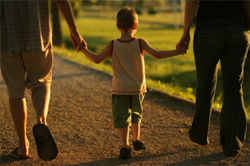
When a person on the outside steps into the circle between parent and child and is critical, it can be difficult. However, in order to remain free of the insensitive or thoughtless remarks of others, not taking offense and forgiving offense are crucial for our personal and parental happiness.
We cannot choose how the neighbors will act; we can only choose how we act and react.
Elder Sorenson promises that as we forgive, "we open ourselves up to a better future. No longer does someone else's wrongdoing control our course, we can focus on the future with God's love in our hearts" (12).
Not taking others' criticism to heart will help us be better parents.
Sources
Bednar, David A. "And Nothing Shall Offend Them." Ensign November (2006): 89-92.
Faust, James E. "The Abundant Life." Ensign October (1985): 7.
Marchant, Michelle, and K. Richard Young. "3 B's of effective parenting: Be proactive, be positive, and be consistent." Marriage and Families, (Winter), 18-25.
Sorenson, David E. "Forgiveness Will Change Bitterness to Love." Ensign May (2003): 10-12.